Laser education
Thulium and erbium lasers: what 1927 nm and 1550 nm mean for your clinic
A dual-wavelength fractional laser gives a clinic two optical tools within one platform. Understanding the distinction between 1550 nm and 1927 nm helps you discuss skin texture, uneven pigmentation and treatment planning with greater precision.
Start with the wavelength and the tissue target
Both wavelengths are used in fractional resurfacing technologies that interact with water in tissue. The 1927 nm wavelength is generally associated with more superficial treatment effects, while 1550 nm systems can produce thermal treatment zones extending further into the dermis. Actual tissue effects also depend on how a particular system delivers its energy. [5]
The word erbium needs care. In this context, 1550 nm refers to an erbium-based wavelength used in non-ablative fractional systems. Er:YAG is a separate laser technology, commonly operating at 2940 nm. Giving the wavelength alongside the device name prevents two different technologies being confused. [4] [5]
What does fractional treatment mean?
Fractional delivery creates an array of microscopic treatment zones with intervening tissue between them. This spatial pattern is central to the technology. It describes how the treatment is distributed; it does not, by itself, specify the depth, intensity or expected recovery period. [1]
For a clinic, this means that a comparison should include the available delivery modes, handpieces and controls. Broad labels such as resurfacing or rejuvenation need to be translated into a specific treatment objective that the practitioner can assess and document.
What has been studied?
A prospective multicentre study of a 1927 nm fractional system reported improvement in photo-induced facial pigmentation. It involved participants with Fitzpatrick skin types I to IV and had a limited follow-up period. Those details matter when deciding how widely the findings can be applied. [2]
A separate prospective study investigated combined 1550 nm and 1927 nm treatment for photodamaged skin. Together, these studies provide background for discussing texture and pigmentation within a consultation. They studied specific systems and populations, so their results should not be presented as a guaranteed outcome for another device or for every client. [3]
The SkinLight Tulium + Erbium 30 W model
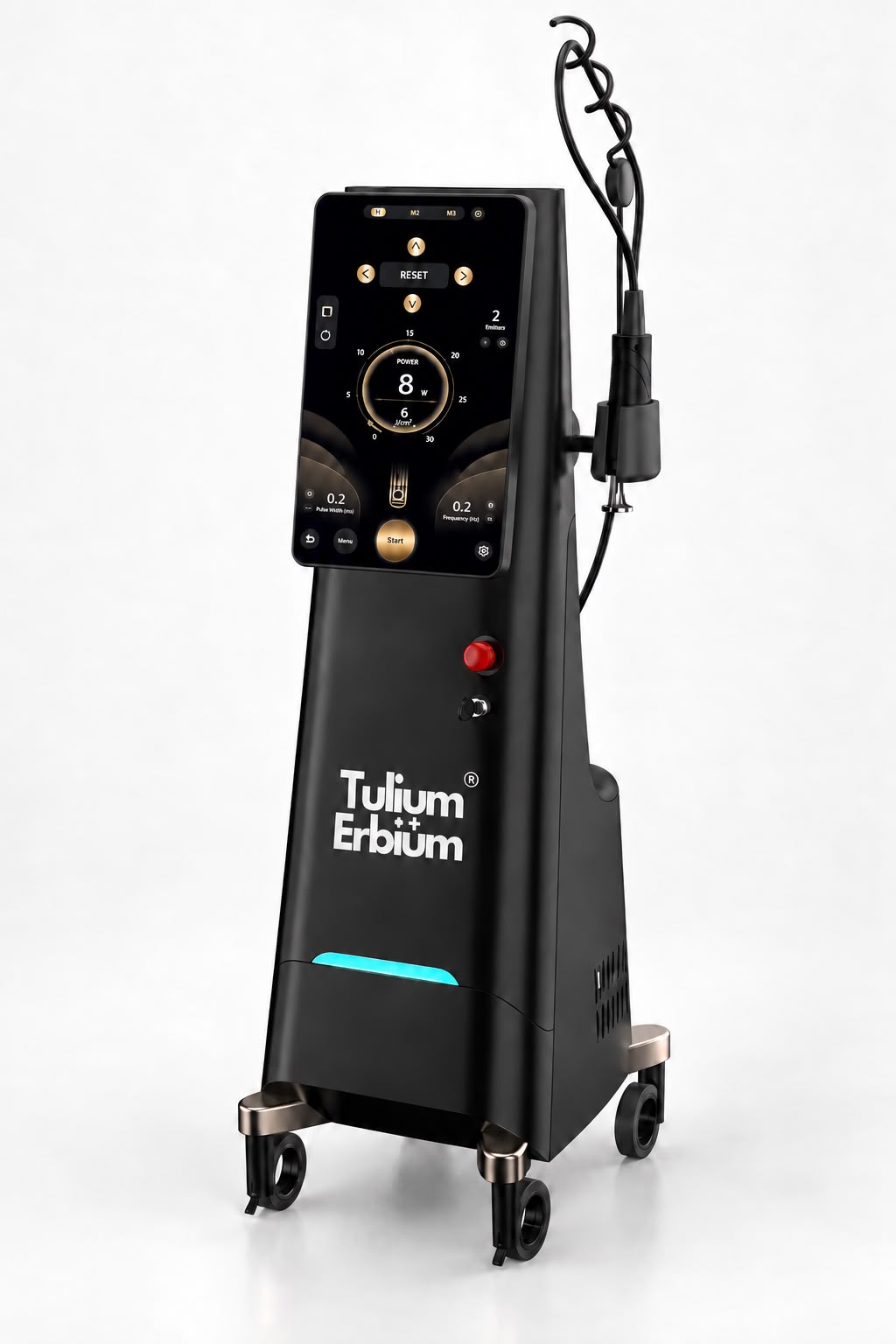
The SkinLight catalogue includes Tulium + Erbium 30 W, combining 1927 nm and 1550 nm. The 30 W designation identifies the model being considered. It is a device specification, rather than a treatment recommendation or a measure of how much change a client will see. [6]
When comparing a package, review the included tips, available modes, required working space and the training associated with the chosen configuration. Ask which services your team is equipped to introduce first and which would require further preparation. This keeps the purchasing conversation aligned with a practical service plan.
Plan for assessment, photographs and follow-up
Uneven pigmentation and altered skin texture can have different causes. A professional assessment should establish what is being addressed, whether it is suitable for the proposed approach and how recovery will be managed. Consistent photographs and a clearly stated review point make later comparisons more meaningful.
SkinLight Academy accepts enquiries about thulium and erbium laser education. Include your professional background, experience with lasers and intended treatment scope. You can also explore appointment capacity and operating costs using the fractional laser example in the calculator.
Questions from clinic teams.
Does 1550 nm mean Er:YAG?
No. The 1550 nm erbium-based wavelength and the commonly used 2940 nm Er:YAG wavelength describe different technologies. Always compare the wavelength and delivery method as well as the name.
Does a higher wattage guarantee a better result?
No. The treatment objective, device characteristics, professional assessment and appropriate use all affect the result. A power specification alone cannot predict an individual outcome.
Sources and further reading.
- Manstein and colleagues: original research on fractional photothermolysis ↗
- Brauer and colleagues: prospective study of 1927 nm treatment for photopigmentation ↗
- Narurkar and colleagues: prospective study of a dual 1550/1927 nm system ↗
- Salisbury NHS: laser types, including 2940 nm Er:YAG ↗
- Solta Medical: dual-wavelength fractional laser mechanism ↗
- SkinLight UK: Tulium + Erbium 30 W configuration ↗